468x60 Ads

Saturday, April 5, 2014

Vijay Antony's third with an interesting title

Music composer Vijay Antony turned as a lead hero with the film Naan that released in 2012. Thanks to the gripping script and Vijay Antony's decent performance, the film was a commercial success as well garnering critical acclaims


This encouraged Vijay Antony produce another filmwith himself playing the lead role. The film has been titled as Salim and it is being directed by N.V.Nirmal Kumar.
No before the release of Salim, Vijay has launched his third acting venture. The film comes with a interesting title 'India Pakistan' and the tagline says 'Toss Pottachu'. The first look poster released today suggest that the film revolves around the game of cricket. The film is going to be directed by debutante N.Anand.

The film kick starts today with a song recording. Like his earlier 'lead hero' ventures, Vijay Antony is producing this flick under his Vijay Antony Film Corporation banner. 

Friday, April 4, 2014

Samsung Galaxy S5 Release Date: Just one week left till launch

The Samsung Galaxy S5 release date is now just one week away, with the Korean manufacturer’s latest flagship phone to hit UK retailers on April 11.


Having been formally unveiled a little under six weeks ago, the wait to get your hands on the Samsung Galaxy S4 follow-on is almost over. The Samsung Galaxy S5 release date will be held alongside the launch of the newly confirmed Samsung Gear 2 and Samsung Gear Fit.

On April 11 we will launch these great products in almost 150 countries,” Jean-Daniel Ayme, Samsung’s Vice President of European Telecommunication Operations announced during the phone’s formal unveiling back at MWC.

Although Samsung has yet to announce an official Samsung Galaxy S5 price, the phone has started cropping up on retailer's online stores priced from £579.95 on a SIM-free basis.

Ahead of the Samsung Galaxy S5 release date, check out out 'Where to buy the Samsung Galaxy S5' page for all the best and latest deals.

Samsung Galaxy S5 Features


Arguably the most eagerly awaited handset of the year, the Samsung Galaxy S5 was first shown off at MWC 2014.

Moving to a 5.1-inch display, the plastic bodied handset is powered by a new 2.5GHz quad-core Qualcomm Snapdragon 801 processor and runs 2GB of RAM.

With an integrated fingerprint scanner and rear-mounted heart rate monitor, the Samsung Galaxy S5 specs sheet is further bolstered by a 16-megapixel rear-mounted camera and 2-megapixel forward-facing snapper. The phone will launch in four colour schemes, black, white, blue and gold.

Running Google’s Android 4.4 KitKat OS and Samsung’s newly finished TouchWiz UI, the Samsung Galaxy S5 features list sees a 28oomAh Lithium-battery promise a 10 hour LTE browsing battery life.

The phone lines up at 8.1mm thick and 145g in weight and will be available in 16GB or 32GB storage options.

Virat Kohli's fiery fifty helps India storm into final

Virat Kohli hit an unbeaten 72 off 44 balls as India chased down South Africa's challenging 172 for four with six wickets in hand at Mirpur. India will play Sri Lanka in the ICC World Twenty20 final on Sunday.

Former champions India upstaged South Africa by six wickets in the second semi-final in Dhaka on Friday to cruise into the final of ICC World Twenty20. Chasing 173 to win, India were led by a swashbuckling knock of 72 not out by Virat Kohli as they strolled to the target with five balls to spare.

This becomes India's second final in five World Twenty20s after they won the inaugural event held in South Africa in 2007. They meet Sri Lanka in the final in Dhaka on Sunday. 

In contrast, South Africa, regarded as perennial chokers in crucial matches, yet again failed to reach any world level final since their readmission into cricket in 1991.

Kohli smashed five boundaries and two sixes off 44 balls in a brilliant display of batting, highlighting India's strength at chasing a target. He hit paceman Dale Steyn for a boundary to seal the win much to the jubiliation of a packed Shere Bangla stadium. (Also read: How Kohli battled back pain to carry India to final)

Kohli and other Indian batsmen blunted South Africa's best bowlers, leg-spinner Imran Tahir -- joint highest wicket-taker so far in the tournament with 12 -- and paceman Steyn with authority. Tahir managed just one wicket for 30 runs in his four overs while Steyn went for 36 in 3.1 overs.

Kohli brought up his seventh T20 fifty with a huge six off Tahir and despite the loss off Yuvraj Singh (18) and Suresh Raina (21) kept the run-chase smooth. Rohit Sharma made a 13-ball 24 with a six and four boundaries and Ajinkya Rahane scored 32 off 30 balls. (In pics: Kohli aims for WT20 trophy)

South Africa, who batted after winning the toss were helped to 172-4 with skipper Faf du Plessis scoring a 41-ball 58 for his fifth Twenty20 fifty. He added 71 for the third wicket with Jean-Paul Duminy who made an unbeaten 40-ball 45 to bolster the innings.

Du Plessis, who missed South Africa's last game against England because of a slow over-rate suspension, hit five boundaries and two towering sixes as the duo negotiated an Indian spin quartet with aggressive batting.

South Africa lost opener Quinton de Kock (six) in the first over before Hashim Amla and Du Plessis took the score to 44 in the fifth over. But Ravichandran Ashwin, who took 3-22 in his four overs, put the brakes on South Africa's progress, claiming Amla (22) and then dangerman AB de Villiers (ten) off a miscued pull shot which was smartly held by Rohit Sharma at long leg.

In between du Plessis and Duminy batted with guts to take South Africa to 115 before Ashwin bowled du Plessis off a miscued sweep. Duminy, who hit three sixes and a four, added another 43 for the unbroken fifth wicket with Andrew Miller (23 not out) to help South Africa add 106 in the last ten overs.

Leg-spinner Amit Mishra, India's most successful bowler in the Super-10 stage, went for 36 runs in his three overs without taking a wicket.

Thursday, April 3, 2014

Bus Topology : Advantages and Disadvantages

What is Bus topology? 


Bus Topology is the simplest of network topologies. In this type of topology, all the nodes (computers as well as servers) are connected to the single cable (called bus), by the help of interface connectors. This central cable is the backbone of the network and is known as Bus (thus the name). Every workstation communicates with the other device through this Bus. 

A signal from the source is broadcasted and it travels to all workstations connected to bus cable. Although the message is broadcasted but only the intended recipient, whose MAC address or IP address matches, accepts it. If the MAC /IP address of machine doesn’t match with the intended address, machine discards the signal. 

A terminator is added at ends of the central cable, to prevent bouncing of signals. A barrel connector can be used to extend it. Below I have given a basic diagram of a bus topology and then have discussed advantages and disadvantages of Bus Network Topology
bus topology diagram,physical bus topology, linear bus network topology, wiki wikipedia

Advantages (benefits) of Linear Bus Topology


1)  It is easy to set-up and extend bus network.
2)  Cable length required for this topology is the least compared to other networks.
3)  Bus topology costs very less.
4) Linear Bus network is mostly used in small networks. Good for LAN.

Disadvantages (Drawbacks) of Linear Bus Topology


1)  There is a limit on central cable length and number of nodes that can be connected.
2)  Dependency on central cable in this topology has its disadvantages.If the main cable (i.e. bus ) encounters   some problem, whole network breaks down. 
3)  Proper termination is required to dump signals. Use of terminators is must.
4)  It is difficult to detect and troubleshoot fault at individual station.
5)  Maintenance costs can get higher with time.
6)  Efficiency of Bus network reduces, as the number of devices connected to it increases.
7)  It is not suitable for networks with heavy traffic. 
8)  Security is very low because all the computers receive the sent signal from the source.

Celiac disease linked to heart problems

People with celiac disease appear to have an increased risk of heart disease. Physicians Rama Gajulapalli and Deepak Pattanshetty of the Cleveland Clinic analyzed a database of more than 22 million people and, using medical coding, identified 24,530 with celiac disease. Probing the records further, they found that 9.5 percent of the celiac patients had coronary artery disease, compared with 5.6 percent of those without celiac. In people age 65 or older, 28.6 percent of celiac patients but only 13.2 percent of the others had coronary artery disease.

Celiac disease is an aberrant immune reaction to consumed gluten, which is found in wheat, rye and barley. Celiac is marked by inflammation of the small intestine, poor nutrient absorption and tissue damage. Inflammation, which also contributes to cardiovascular risk, might underlie the nearly doubled risk, Gajulapalli reported March 29 at a meeting of the American College of Cardiology.  

Wednesday, April 2, 2014

Samsung launches 28-inch 4K billion-color UD590 monitor


Time to get that second graphics cards, guys: Samsung has announced that its 28-inch 4K UD590 monitor will soon be available in the US for the paltry sum of $700. The UD590 packs a 28-inch 3840×2160 TN panel (157 PPI), capable of displaying 10-bit color (1 billion colors) at 60Hz with 1ms GTG response time. Priced at $700, this is probably your best bet if you want to try your hand at 4K gaming — or, if you’re a creative of some kind, the idea of 10-bit color on a 4K display should be very, very alluring.

From what we can tell, the UD590 has been available as a gray import from South Korea for a month or two — but now Samsung is preparing to launch it officially in the USA. Design-wise, the UD590 has a very minimal stand and bezel that’s finished in silver and black — in my opinion it’s much more attractive than the Dell P2815Q, the other $700 4K monitor that’s currently on the market. There are no DVI connectors, two HDMI connectors, and a single DisplayPort connector (which is what you need to use, if you want 3820×2160 @ 60Hz).


But enough about the minutiae — let’s get down to nitty-gritty here. In particular, that 10-bit TN (twisted nematic) panel. As you may know, in today’s market, there are two primary underlying technologies used in LCD displays: TN and IPS (including Samsung’s PLS). TN is cheap and fast, but IPS has wider viewing angles and generally better color fidelity. Personally, I have never heard of a 10-bit TN panel before; usually, if you want 10-bit color (10 bits per pixel, or bpp) you have to spend a lot of money ($1000+) on a professional-grade IPS monitor. To think that you can get a 10-bit 4K monitor for $700 makes me a little dizzy.


Unfortunately, even though the UD590 has been available as a gray import, none of the reviews online appear to mention the monitor’s color fidelity/image quality. The official Samsung specs don’t offer much in the way of guidance, except to say that it can display 1.07 billion colors, that it has 1-millisecond gray-to-gray (GTG) response time, standard 300 cd/mbrightness and 1000:1 contrast (or 10,000,000:1 dynamic contrast, if you prefer), and that there’s the usual poor viewing angles associated with TN panels.


Unfortunately, even though the UD590 has been available as a gray import, none of the reviews online appear to mention the monitor’s color fidelity/image quality. The official Samsung specs don’t offer much in the way of guidance, except to say that it can display 1.07 billion colors, that it has 1-millisecond gray-to-gray (GTG) response time, standard 300 cd/mbrightness and 1000:1 contrast (or 10,000,000:1 dynamic contrast, if you prefer), and that there’s the usual poor viewing angles associated with TN panels.


Powerful earthquake strikes off Chile, triggers tsunami

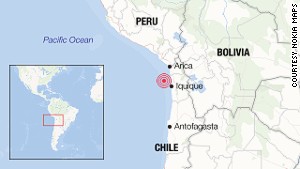
A mighty 8.2-magnitude earthquake struck off the coast of northern Chile late Tuesday, triggering small landslides, sapping power and generating a tsunami.
Four men and one woman died -- two due to heart attacks and three crushed to death, said Interior Minister Rodrigo Penailillo.
About 300 prisoners escaped from the northern port city of Iquique in the immediate aftermath, he said.
The quake struck about 8:46 p.m. local time, some 60 miles northwest of Iquique. It had a depth of 12.5 miles, the U.S. Geological Survey said.
Chile's National Emergency Office asked everyone to evacuate the South American nation's coast. And residents complied.
"The fact is, we will know the extent of the damage as time goes by and when we inspect the areas in the light of day," Chile's President Michelle Bachelet said early Wednesday morning. "The country has faced these first emergency hours very well."

Residents in the port city of Antofagasta,calmly walked through the streets to higher ground as traffic piled up in some places.


"Many people are fearful after experiencing the powerful earthquake in 2010, so they immediately fled for higher ground when they heard the tsunami warning," said Fabrizio Guzman, World Vision emergency communications manager in Chile.

"There have been multiple aftershocks and communications have been cut off in many of the affected areas. So people are waiting in the dark hills not knowing what is to come, and hoping they will be able to return to their homes safely."

At one point, the Pacific Tsunami Warning Center issued several tsunami warnings. All of them, including for Chile and Peru, were canceled early Tuesday morning. All tsunami watches, which once extended as far north as Mexico's Pacific coast, were called off as well.

Tsunami waves of more than 6 feet generated by the earthquake washed ashore on the coast of Pisagua, according to Victor Sardino, with the center.

Iquique, with a population of more than 200,000, saw waves 7 feet high.

'No hazards' to U.S. coastline

The U.S. National Tsunami Warning Center worked Tuesday to determine the level of danger for Alaska, Washington, Oregon and California, as well as Canada's British Columbia.
Gerard Fryer, a geophysicist with the Pacific Tsunami Warning Center, told CNN there is "clearly not going to be any hazards to the coastline of North America."

The Pacific Tsunami Warning Center issued a tsunami warning for Hawaii, saying strong currents may pose a hazard to swimmers and boaters.